A spout sits in a narrow, awkward position, so hand welding tends to leave uneven spots and a dirty-looking finish. This cell fixes the position and the parameters: dual touchscreen control, laser welding, dense welds and a consistent appearance.
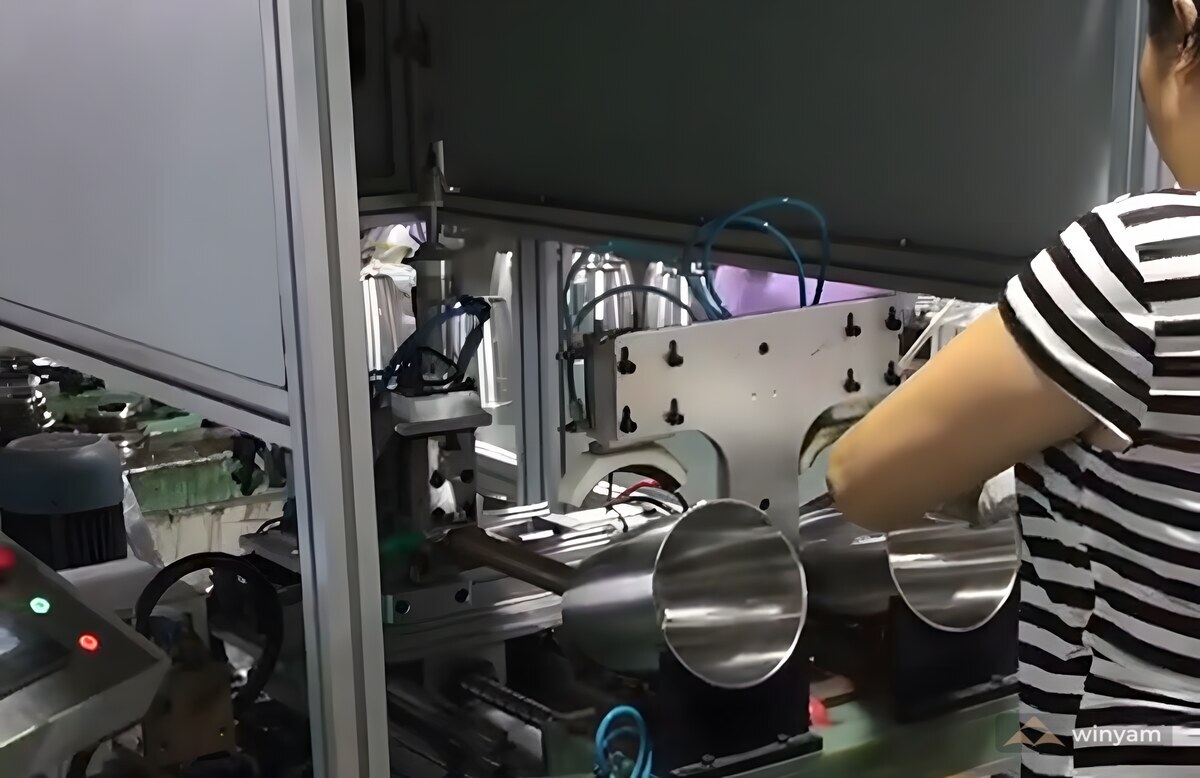 Running on a customer site
WHY A DEDICATED MACHINE
A spout is the face of the product — an uneven weld, a dark spot or a leak is the first thing a customer notices. The value of a dedicated cell is that angle, position, power and dwell become a recipe: the operator only loads and unloads, and on a spout changeover you recall a recipe instead of hunting for the touch again.
| Item | By hand | By machine |
|---|---|---|
| Weld consistency | Varies with the operator | Fixed parameters, batch to batch |
| Appearance | Darkening, uneven spots | Fine welds, clean finish |
| Changeover | Re-learn the touch | Recall a recipe |
| Staffing | Needs a skilled welder | Any operator can load and unload |
| Yield | Lower and unpredictable | Steadier, less rework |
SPEC & CONFIGURATION
Output, cycle time and dimensions depend on your part, so we don't publish estimates. Firm figures are quoted at proposal stage against your actual workpiece.
| Parts | Kettles, vacuum pots, coffee pots — spout and short-tube welding |
| Machine form | Benchtop, single station, dual touchscreen interface |
| Welding | Laser welding, parameters calibrated per spout type |
| Loading | Manual load/unload, foot-pedal start |
| Control | PLC + touchscreen, recipes stored and recalled |
| Tooling | Fixture built to your spout shape and position |
| Integration | Can be linked with rolling/seam welding, polishing and inspection into a line |
| Output / cycle / footprint | Calibrated to spout type and tooling; firm figures at proposal stage |
DELIVERY & ACCEPTANCE
01
Part dimensions, target output, existing process and site conditions are agreed before the machine is configured.
02
You test with your own parts and approve cycle time and finished quality before shipment.
03
We install, tune the parameters, and run it until it produces steadily.
04
Operator and maintenance training; long-term technical support, on site when needed.
RELATED EQUIPMENT
FAQ
These are the questions that actually come up on calls and on site. Answers describe how we really work, including what we can't do.
Leaks are the thing that matters most in spout welding, and it's where we are least willing to be vague. A leak usually comes from two places: the fit-up gap between spout and body, or the weld path not matching. Laser welding is very sensitive to gap — too wide and it won't penetrate, too tight and it burns through. We clamp the spout into position with a locating fixture first, then weld with parameters calibrated to that part, not to a welder's feel.
A laser seam is narrow with no raised bead, so normally it needs no grinding. If the seam lands on a visible face and the part must be mirror or brushed finish, it still gets one polishing pass. That's still less work than TIG — the bead you get at a kettle rim with TIG almost always has to be ground off, and that's one more process and one more person.
Yes, but the tooling is completely different. A single-wall kettle is thin (0.4–0.6 mm), so power comes down and speed goes up. A double-wall pot welds the joint between inner and outer shells, and the vacuum layer must not be breached. One fixture cannot do both. Send the shapes and wall thicknesses and I'll tell you whether it should be two machines.
Yes, provided cycle time and load/unload method agree. Either a standalone station with manual loading, or inline in your conveyor so parts flow automatically. Inline needs communication and cycle synchronisation (stop when upstream is empty or downstream is full), which is line integration work and gets laid out on the drawing.
Driven by spout type, whether you need automatic loading, and whether it goes inline. A single station with manual loading and an inline unit are two different budgets. Send spout type, wall thickness and required cycle time, and I'll quote a range against a proposal.
The laser source itself is maintenance-free, but protective lenses are inspected and replaced on a schedule — spatter contaminates them and a dirty lens costs you power. It's a normal consumable, not expensive, but it has to be changed on time rather than after you notice the weld doesn't penetrate.
Sampling is the right starting point. Send spouts and bodies, a dozen sets each. We weld them and show you the seam appearance plus a pressure or leak test, so you can judge whether the seam is acceptable.
If spout position or angle changes, you change the tooling and re-teach the path. Different batches of the same spout only need parameter tweaks. How many spout types you run and how often you switch is what decides whether we build quick-change tooling.
GET IN TOUCH
Send the product type, part dimensions, target output and your current process. We come back with cycle time and layout thinking first, then a proposal and price range.
Replies within one business day.