Rolling and seam welding become one process on one machine. Welding is the step a flask line cannot afford to get wrong: the seam decides the seal, the seal decides insulation, and insulation is what your customer is buying.
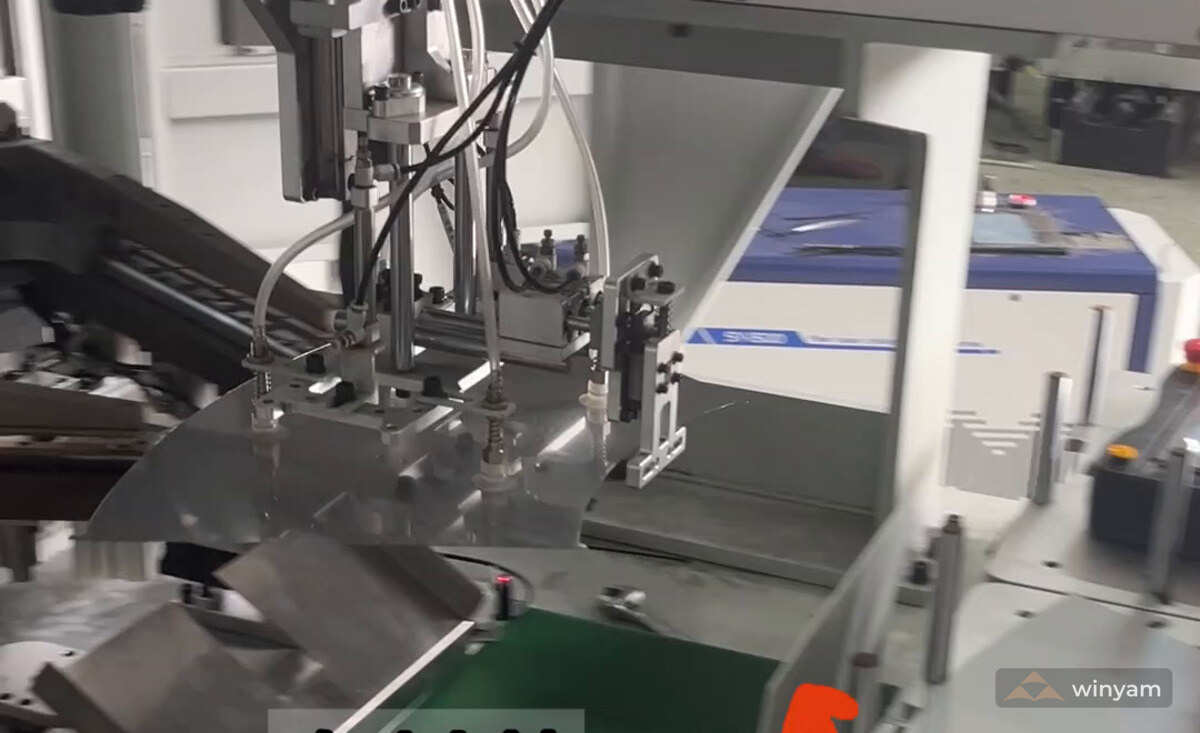 Running on a customer site
WHY LASER WELDING
TIG welding presses and fuses the joint, which tends to distort the part and leave a raised bead. Laser welding is non-contact, with a small heat-affected zone and a continuous, dense seam. For your customer this is not a cosmetic upgrade — it is the stability of yield and seal.
| Item | By hand | By machine |
|---|---|---|
| Seam profile | Wide | Narrow and fine |
| Appearance | Raised bead at the rim | No bead, smooth surface |
| Seal | Hard to weld perfectly at the details | Dense seam, reliable seal |
| Distortion | Pressure brings distortion risk | Non-contact, no pressure |
| Yield | Lower | Higher, less rework and scrap |
SPEC & CONFIGURATION
Output, cycle time and dimensions depend on your part, so we don't publish estimates. Firm figures are quoted at proposal stage against your actual workpiece.
| Parts | Roll forming and longitudinal seam welding of flasks, kettles and stainless cylinders |
| Process | Automatic rolling + laser seam welding, one station |
| Loading | Manual load with foot-pedal start; automatic loading available as an extension |
| Welding | Laser welding, dual-fixture location |
| Control | PLC + touchscreen, welding recipes stored per size |
| Size range | Calibrated to your cup type or cylinder diameter |
| Integration | Can be linked with polishing, inspection and assembly into one line |
| Output / cycle / footprint | Calibrated to the workpiece; firm figures at proposal stage |
DELIVERY & ACCEPTANCE
01
Part dimensions, target output, existing process and site conditions are agreed before the machine is configured.
02
You test with your own parts and approve cycle time and finished quality before shipment.
03
We install, tune the parameters, and run it until it produces steadily.
04
Operator and maintenance training; long-term technical support, on site when needed.
RELATED EQUIPMENT
FAQ
These are the questions that actually come up on calls and on site. Answers describe how we really work, including what we can't do.
The gain is one less transfer and one less clamping; the cost is that a single fault affects both halves. So the two halves must move and be tuned independently: if the welding head has a problem, rolling can still run empty; if you change the rolling die, the welding recipe library is untouched. If you want belt-and-braces, two separate machines also work — the price is an extra load/unload and one more positioning error.
A leaking longitudinal seam is usually lack of penetration or porosity. Three things matter in laser welding: gap, power and shielding gas. If the gap exceeds tolerance it won't penetrate, so butt accuracy after rolling must be stable — which is exactly why rolling and welding belong on one machine: one less transfer is one less chance to deform. Seam integrity is verified by pressure test or leak test, sampled per batch.
Rolling changeover means a different roll or die; welding means a different program. Same diameter, different height: ten minutes of programming. Different diameter: change the rolling module, half a day. How many sizes you run per month decides whether we build quick-change into the machine — and that has to be settled at proposal stage.
Absorption is lower than carbon steel, but it welds perfectly well — the parameters have to be calibrated to material and surface condition. Brushed, mirror and oiled parts all need different settings. We sample each part, store a parameter set as a recipe, and recall it on the next run. It isn't a knob an operator twiddles on the day.
Driven by cylinder diameter range, whether you need automatic loading, and whether rolling and welding are one machine or two. The price gap and the throughput difference both need to be laid out. Send diameter range, sheet thickness and target cycle time, and I'll quote a range against a proposal.
The laser source is maintenance-free. Protective lenses are inspected and replaced on a schedule, and cooling water is changed on the maker's interval. Those three decide whether a laser stays reliable long term — cheap, but somebody has to own them, so we write them into your check sheet.
Yes. Send sheet or semi-finished cylinders, we weld, then pressure test and section the seam to check penetration. Sectioning is the only honest way to judge a weld; photographs are not.
Same diameter, different height: ten minutes of programming. Different diameter: change the rolling module, half a day. How many diameters you intend to run is what decides whether we build quick-change in from the start.
GET IN TOUCH
Send the product type, part dimensions, target output and your current process. We come back with cycle time and layout thinking first, then a proposal and price range.
Replies within one business day.